
NAVIGATING A CHANGING PROPERTY MARKET
As we enter October, South Africa's property market finds itself navigating another important shift in the economic landscape.
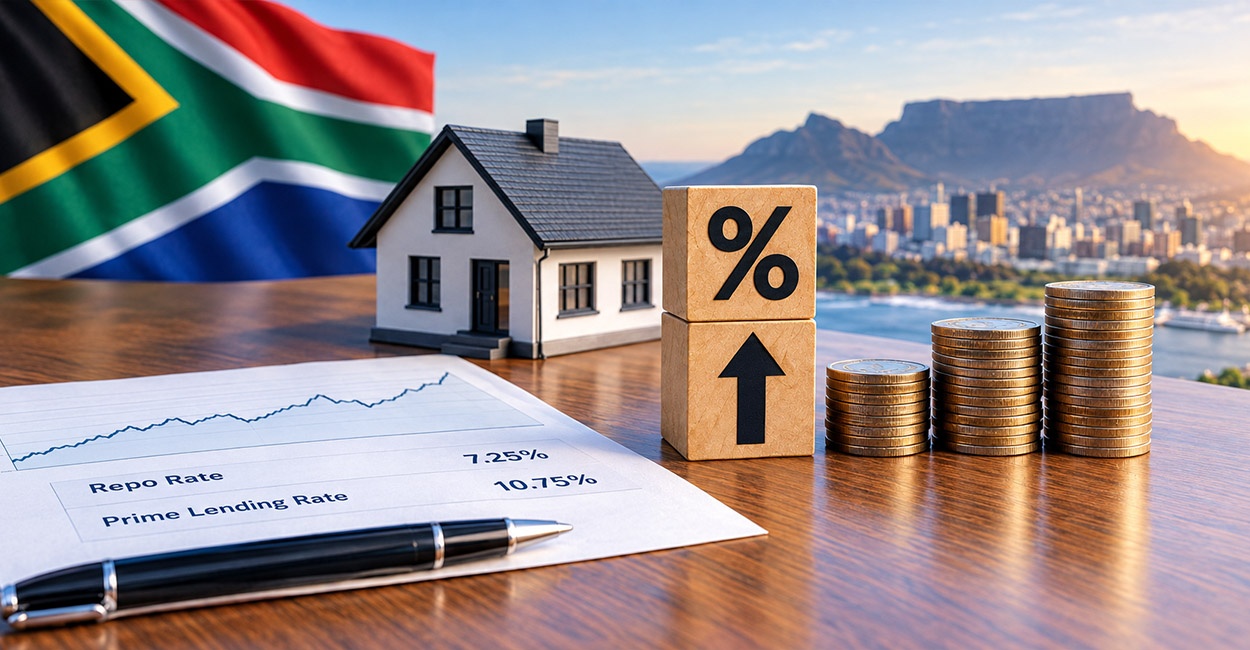
On 23 September 2026, the South African Reserve Bank's Monetary Policy Committee (MPC) announced a 25-basis-point increase in the repo rate, taking it from 7.00% to 7.25%.
The decision, which took effect on 25 September, brings the prime lending rate to 10.75%.
For anyone with a home loan, considering purchasing property, investing in real estate or managing a property portfolio, the question is naturally:
What does this mean for me and my property plans?
At Dainty Diamond Properties, we believe that informed property decisions begin with understanding the market — not reacting to headlines.
THE RATE DECISION AT A GLANCE
The latest increase is the second repo-rate increase of 2026, following the 25-basis-point increase in May.
The MPC's decision was unanimous.
According to the Reserve Bank, the move comes at a time when the global economic environment remains highly uncertain. Escalating geopolitical tensions, disruptions to oil supplies and higher international interest rates have created additional inflationary pressure.
South Africa's annual consumer inflation rate increased from 4.3% in July to 4.4% in August 2026.
While some areas of inflation have shown encouraging developments, the Reserve Bank remains concerned about renewed fuel-price pressures and the possibility that temporary price increases could become more widespread across the economy.
The Bank's current inflation target is 3%, with the MPC focused on returning inflation sustainably towards that level.
The Reserve Bank currently expects headline inflation to rise above 5% later this year and into early 2027 before easing as the fuel-price shock recedes. Its latest projection is for inflation to return to around 3% towards the end of 2027.
Source: South African Reserve Bank, September 2026 MPC Statement.
WHY DID THE RESERVE BANK RAISE RATES?
The decision is closely linked to the renewed global oil and fuel-price shock.
According to the Reserve Bank, geopolitical conflicts have disrupted global supply chains and oil flows, creating what it describes as a significant global supply shock.
Fuel prices had moderated between June and August, but renewed international oil-price pressures have changed the outlook.
The Reserve Bank estimates that petrol prices are rising again, with an average under-recovery of approximately R2.83 per litre at the time of its September MPC decision.
Higher fuel prices can affect much more than what motorists pay at the petrol station.
Transport costs can feed into the prices of goods and services, creating what economists refer to as second-round inflation effects.
This is one of the reasons the MPC is taking a cautious approach.
The Reserve Bank has stated that its objective is not simply to respond to every temporary price movement, but to prevent large and sustained shocks from becoming entrenched in inflation expectations.
WHAT DOES THIS MEAN FOR THE PROPERTY MARKET?
Interest rates and property are closely connected.
For most South Africans, purchasing a home involves some form of financing. When the prime lending rate increases, the cost of borrowing generally increases for consumers whose loans are linked to prime.
This can affect:
• Monthly bond repayments
• The amount a buyer can qualify to borrow
• Household affordability
• Investment financing costs
• The pace at which some buyers enter the market
The latest 25-basis-point increase therefore places some additional pressure on affordability.
However, it is important to put the increase into perspective.
The current prime lending rate of 10.75% remains below the 11.75% level reached in 2023.
That means the current lending environment, although more expensive than earlier in 2026, is not at the highest borrowing-cost levels experienced in the recent cycle.
A MARKET THAT IS STILL SHOWING RESILIENCE
The interest-rate increase does not mean that the South African property market has come to a standstill.
Recent property-market data points to a market that continues to function, although affordability remains an important constraint.
According to FNB's latest property research, national house-price growth moderated to 4.9% year-on-year in August 2026, from 5.3% in July.
FNB describes the residential property market as resilient, but notes that current conditions are increasingly supported by limited housing supply and financially stronger buyers rather than broad-based growth in demand.
This distinction is important.
A property market can experience positive price growth while some buyers continue to face affordability challenges.
For buyers, this makes budgeting, affordability assessments and careful property selection increasingly important.
For sellers, it reinforces the importance of realistic pricing and understanding current buyer demand.
For investors, it highlights the importance of considering rental income, financing costs, location and long-term fundamentals rather than relying solely on short-term price movements.
FOR HOME BUYERS: DON'T LET THE HEADLINE MAKE THE DECISION FOR YOU
For prospective buyers, a rate increase can understandably create uncertainty.
But property decisions should be based on your individual financial position rather than on the headline alone.
Before entering the market, buyers should consider:
1. YOUR AFFORDABILITY
Understand what monthly repayment you can comfortably sustain — not simply the maximum amount a bank may approve.
2. YOUR DEPOSIT
A larger deposit can reduce the amount you need to finance and may also improve your overall financing position.
3. YOUR CREDIT PROFILE
Your credit record remains an important part of the home-loan process.
4. THE TOTAL COST OF OWNERSHIP
A property involves more than the bond repayment.
Buyers should also consider rates and taxes, levies where applicable, insurance, maintenance and other ongoing costs.
5. THE PROPERTY ITSELF
Location, condition, future development, rental demand, accessibility and the property's long-term suitability should all form part of the decision.
The right property decision is not necessarily about buying when rates are at their lowest. It is about buying a property that makes financial and practical sense for you.
FOR SELLERS: VALUE AND POSITIONING MATTER
Changing interest rates can influence buyer affordability.
That makes accurate pricing increasingly important.
Overpricing a property can reduce the pool of potential buyers, particularly when buyers are already carefully assessing their monthly affordability.
A well-positioned property, supported by competitive pricing, strong presentation and effective marketing, has a better opportunity to attract serious attention.
At Dainty Diamond Properties, our role is not simply to put a property on the market.
We help sellers understand the market, position their property appropriately and connect with prospective buyers.
FOR PROPERTY INVESTORS: LOOK BEYOND THE INTEREST RATE
Property investment requires a longer-term perspective.
Higher borrowing costs can affect the financing side of an investment, but investors should assess the complete picture.
Consider:
Rental demand
Expected rental income
Vacancy risk
Property expenses
Financing costs
Location
Potential long-term capital growth
Tenant profile
Supply and demand within the area
A strong investment decision is one where the numbers work under realistic assumptions — not only under the most favourable scenario.
For investors financing property, it is particularly important to understand how changes in interest rates could affect cash flow.
THE ECONOMY: A DELICATE BALANCE
The Reserve Bank's latest decision also reflects a broader challenge facing South Africa.
The economy contracted by 0.2% in the second quarter of 2026.
The SARB nevertheless expects a rebound during the second half of the year, while its annual growth projection for 2026 has been revised to 1.2%, down from 1.4%.
The Bank continues to project growth of around 2% over the medium term, but says risks to the growth outlook are tilted to the downside.
This creates a difficult balancing act.
Higher interest rates can help contain inflation, but higher borrowing costs can also place pressure on households and businesses.
The Reserve Bank therefore has to consider both inflation risks and economic growth conditions when making monetary-policy decisions.
THERE IS SOME ENCOURAGING NEWS
Not every economic indicator is moving in the wrong direction.
The Reserve Bank notes that food inflation is currently at its lowest level since 2010.
The stronger rand has also helped contain import-price pressures, while agricultural conditions have generally remained favourable.
Core goods inflation has also been more contained.
These factors provide some relief even as fuel and services inflation remain areas of concern.
The picture is therefore more nuanced than simply saying that "inflation is rising."
Some parts of the economy are experiencing significant pressure, while others are showing improvement.
WHAT SHOULD PROPERTY OWNERS DO NOW?
For existing homeowners, the latest rate increase is a reminder to review household finances.
Consider reviewing your:
• Monthly bond repayment
• Household budget
• Emergency savings
• Interest-rate exposure
• Insurance
• Property maintenance
If your budget has become tighter, understanding your finances early gives you more options than waiting until financial pressure becomes severe.
Homeowners should also avoid making major decisions based solely on short-term market headlines.
Property is generally a long-term asset, and individual circumstances matter.
WHAT ABOUT THE NEXT INTEREST-RATE DECISION?
The Reserve Bank's next scheduled MPC announcement is 19 November 2026.
The September MPC statement makes it clear that future decisions will be made meeting by meeting, based on incoming data and the balance of risks.
The Reserve Bank's own modelling currently shows the policy rate broadly stable through the remainder of 2026, with cuts appearing later in its forecast as inflation moves back towards the 3% target.
However, the SARB stresses that this projected path is not a promise.
Future interest-rate decisions will depend on economic conditions, inflation, global developments and other available data.
DAINTY DIAMOND PROPERTIES' PERSPECTIVE
The property market is changing — but change also creates opportunities.
For buyers, the current environment reinforces the importance of affordability and careful research.
For sellers, it reinforces the importance of realistic pricing and strong property presentation.
For landlords, it highlights the importance of effective property management and understanding tenant affordability.
For investors, it reinforces the value of looking beyond short-term movements and assessing the fundamentals of each opportunity.
And for anyone simply wondering whether now is the right time to make a property move, the answer will depend on your financial position, objectives, and the property itself.
There is no single decision that is right for every buyer, seller or investor.
At Dainty Diamond Properties, we are committed to helping our clients navigate those decisions with reliable information, professional guidance and a clear understanding of the market.
MORE THAN JUST PROPERTY
A home is more than a transaction.
It is where families build memories.
It is where businesses grow.
It can be a source of income, an investment for the future, or simply a place of comfort, security, and peace.
That is why our approach extends beyond buying and selling.
Whether you are looking to:
🏡 BUY
🏷️ SELL
🔑 LET
🏢 MANAGE
📈 INVEST
or simply need PROPERTY ADVICE, Dainty Diamond Properties is here to assist.
We don't just help you find property.
We help you make informed property decisions.
OCTOBER 2026 MARKET MESSAGE
The market may change. Your property goals don't have to.
Stay informed.
Plan carefully.
Understand your numbers.
And when you're ready to make your move, make it with confidence.